The European Commission imposed a 120 million euro penalty on X on 5 December 2025. This marks the first enforcement action under the Digital Services Act of the European Union. The fine earned criticisms from Elon Musk and supporters of the Trump administration, who consider the decision a politically motivated attack on a United States tech company.
Specific Violations Under the Digital Services Act
Officials said that X, formerly known as Twitter, violated transparency and data-access obligations in three main areas. First, the blue check mark, which originally indicated verified user identity, is now available to paying users via subscription under the ownership of Musk. The Commission argued that this pay-to-play system undermines the meaning of verification.
The Commission added that the system has made it difficult for users to determine whether an account truly belongs to who it claims, and furthered that this scheme opens the door for fraudulent activity, stolen or impersonated identities, scams, and misleading content. Take note that this particular area of violation alone earned X a fine worth 45 million euros.
Second, the ad repository of X was found non-compliant to the transparency and accessibility requirements set in the Digital Services Act, meaning users, researchers, or authorities could not reliably track or audit ads. The law requires online platforms to maintain a public, accessible, and up-to-date registry of all advertisements. X was fined 35 million euros for this.
The third area centers on the failure of X to provide access to public data, like views and likes. The law requires platforms to grant independent researchers access to certain public data to study systemic risks. The Commission ruled that X shuts out researchers by restricting access or making it too difficult. A fine of 40 million euros was imposed for this.
Note that the three separate areas of violations total 120 million euros. The penalty is considered relatively modest compared with the maximum fine allowed under the Digital Services Act. This hints at the possible level of seriousness of the violations. Online platforms can be charged up to 6 percent of their global revenue depending on the severity of the violations.
Further Details and Responses From U.S. Figures
The Commission first opened formal proceedings against X in late 2023, following the ownership of Musk and the rebranding of Twitter to X, triggering concerns over changes to content moderation, verification, and transparency. Regulators investigated the practices of the platform around user verification, advertisements, and false information or illegal content propagation.
Nevertheless, while EU officials argue the penalty is not about content censorship, but about user protection, transparency, and accountability, Musk and other U.S. politicians, including supporters of the second Trump administration, framed the decision as undermining free speech and tech innovation, and a politically motivated attack against a U.S. tech company.
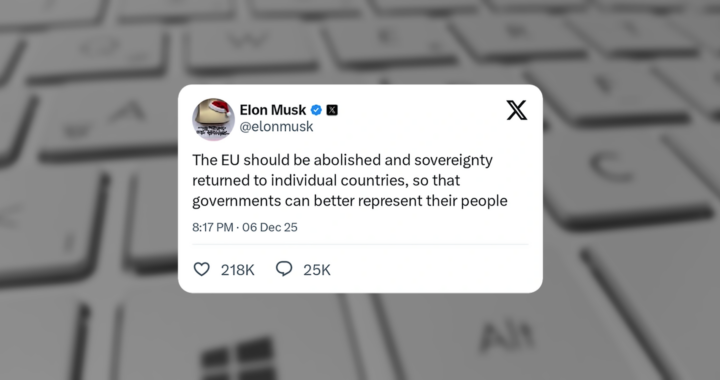
Musk, in a statement he wrote on X on 6 December 2025, said the EU should be abolished, and sovereignty returned to individual countries, so that governments can better represent their people. Republican Senator Ted Cruz also said, via a post on X on 5 December 2025, that U.S. President Donald Trump should sanction the European Union until the decision is reversed.
Secretary of State Marco Rubio added, also through an X post, that the fine is not only an attack on X but also an attack on all American technology platforms and the American people by foreign governments. Vice President JD Vance noted, before the fine was announced, that the EU should be supporting free speech and not attacking American companies over garbage.
Musk and his supporters have also raised a critical point regarding the decision over the blue check marks. They argued that Twitter, before the Musk acquisition and rebranding to X, also sold the iconic user-verified badge. The price even went as high as 1000 U.S. dollars. Musk noted that the current and cheaper subscription scheme was his way of democratizing access.
FURTHER READINGS AND REFERENCES
- Cruz, T. 6 December 2025. “The European Commission…” X. Available online
- Musk, E. 6 December 2025. “The EU should be abolished…” X. Available online