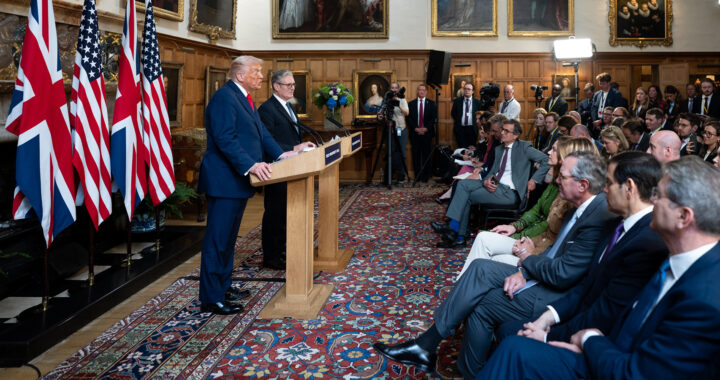
The United States government has officially put on hold a landmark 42 U.S. dollar technology prosperity deal with the United Kingdom. The deal, which was intended to be a cornerstone of the special relationship under the second Trump administration and the Labour government of Keir Starmer, is now stalled due to significant trade and regulatory disagreements.
Note that the deal was signed in September 2025 during the state visit of U.S. President Donald Trump. It was touted as a generational step change that included billions of pledges from U.S. tech giants, which included 22 billion U.S. dollars from Microsoft and 5 billion U.S. dollars from Google, and the creation of a dedicated AI hub in the North-East of England.
The deal also included other technological collaborations between the two countries and relevant companies. The most notable ones include joint efforts in quantum computing innovation, nuclear energy research, and the advancement of sixth-generation wireless communication technology. The goal was to ensure and assert Western dominance over these critical fields.
However, the second Trump administration, led in negotiations by Commerce Secretary Howard Lutnick, has cited a lack of progress by the U.K. in lifting specific trade barriers. The three primary sticking points are the Digital Services Tax, which levies a 2 percent tax on key online-enabled services, the Agricultural Standards, and specific online safety regulations.
Officials from the U.K. government are attempting to project a sense of calm despite the setback. The pause has been described as a standard hardball negotiation tactic used by the U.S. to gain leverage. Moreover, while acknowledging the desire of the U.S. for deregulation, U.K. officials maintain that they will stand their ground to protect U.K. interests and standards.
Starmer had channeled political capital to secure the deal. The pause is a significant blow. It can be recalled that he hosted Trump for an unprecedented second state visit at Windsor Castle in September, specifically to avoid punitive tariffs and secure this investment. The issue also threatens the narrative of post-Brexit economic growth driven by high-tech industries.
The second Trump administration has underscored that the flow of multi-billion-pound technology investments is strictly conditional on the U.K. government conceding to demands of the U.S. government regarding critical trade barriers such as taxes, agricultural trade standards, and other safety regulations. Negotiations are expected to continue in January 2026.