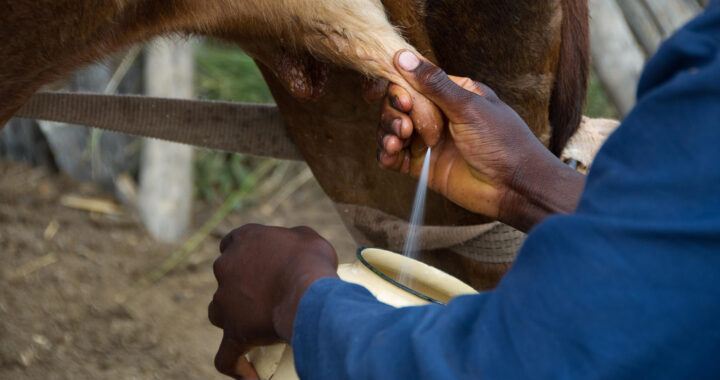
Most humans naturally lose the ability to digest lactose, the sugar in milk, after childhood. Only some populations evolved a genetic trait called lactase persistence. This persistence allows adults to keep drinking milk without problems.
Lactose persistence is very common in Europe but much rarer in South Asia. Most people of South Asian descent, who include Indians, Pakistanis, and Bangladeshis, are lactose intolerant. This is a paradox because South Asia is one of the biggest dairy producers in the world.
A team of researchers analyzed ancient and modern DNA from South Asia to understand this mismatch. They found that a gene variant or allele, called -13910*T, which allows adults to digest milk, did not originally evolve in South Asia. Instead, it arrived thousands of years ago with migrating pastoralist groups from the Eurasian Steppe.
However, unlike in Europe, this allele did not spread widely among most South Asian populations. The study specifically revealed that this is likely because South Asian cultures adapted in a different way.
Rather than relying on fresh milk, people traditionally consumed dairy in processed forms such as yogurt, curd, butter, and ghee. These dairy products contain much less lactose and are easier to digest. The regular consumption of these milk derivatives throughout generations reduced the evolutionary pressure to develop milk-digesting alleles.
It is also worth mentioning that two small South Asian groups, the Toda of southern India and the Gujjar of Pakistan, do show a very high frequency of the lactase persistence allele.
The researchers noted that these two groups traditionally depended heavily on fresh milk from buffalo for nutrition. This has made lactase persistence far more beneficial and thus far more strongly selected.
In brief, some pastoralist groups developed lactase persistence because fresh milk was a central component of their diets. Elsewhere, including South Asia, dairy products were traditionally consumed in forms with reduced lactose, thus reducing the selective pressure for lactase persistence.
Note that the study still underscores the fact that there is no single story of how the ability to digest adult milk evolved. What it implies is that cultural practices around food can significantly influence genetic selection and human dietary evolution.
FURTHER READING AND REFERENCE
- Kerdoncuff, E., Marohn, M., Cramer, N., Dey, S., Kardia, S., Thangaraj, K., Ségurel, L., Lee, J., Dey, A. B., and Moorjani, P. 2025. Revisiting the Evolution of Lactase Persistence: Insights from South Asian Genomes. Cold Spring Harbor Laboratory. DOI: 1101/2025.11.05.686799